- SMART Marketing
- Posts
- Product is a marketing decision.
Product is a marketing decision.
This is Part 2 in the series: Marketing as a Decision-Making Lens

Rahwa Gebremeskel
November 18, 2025
There’s a moment in every business journey where pressure outweighs clarity. The product is built. Expectations are high. But the market response is… quiet.
That’s when many businesses slip into what I call the Vegetarian Lion Trap.
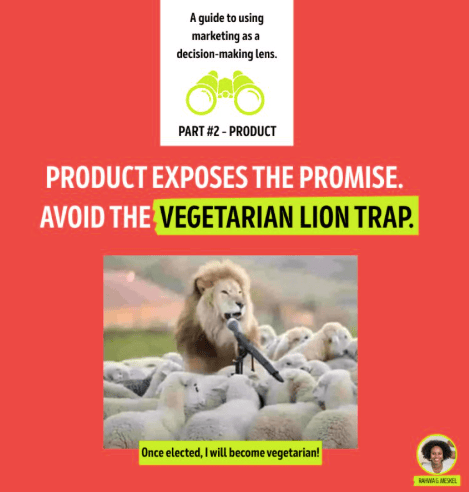
Imagine a lion, under pressure to fit in, declaring itself vegetarian. It knows that’s not true, but the hope is, maybe this softer story will get it accepted. The problem in this calculation is the fact that the lion still goes hungry and no-one will believe it.
This is what happens when businesses build first and then retrofit the marketing. They try to be everything to everyone, saying what sounds good instead of what’s true. A lack of product-market fit forces businesses into roles they can’t sustain.
In this article, I’ll explore three areas where this trap shows up:
What you build shapes what you can say
Every product sends a message
Context shapes how your product lands
Let’s get into it.
1) What you build shapes what you can say
Every product decision is also a positioning decision — whether you realize it or not. From the problem you choose to solve to the audience you prioritize, you're setting the boundaries for what your brand can credibly promise.
Before a single campaign goes live, your product has already spoken. And if there’s a disconnect between what it delivers and what you're trying to say about it, the marketing will always feel forced.
This is where many businesses start to slide into the Vegetarian Lion Trap. They feel pressure to sell, so they stretch the truth. They describe the product they wish they had built, instead of the one that’s actually in front of them.
That’s why product decisions should be made with marketing in mind. The more intentional you are about what you build, the clearer and more effective your marketing will be later.
2) What you build shapes what you can say
Long before someone reads your sales page or watches your launch video, they’re picking up signals from your product. Products speak. From how it's priced to how it performs, every detail communicates something to your audience. The question is whether it's saying what you intended.
A clunky onboarding flow signals complexity. A vague offer creates confusion. An outdated design quietly lowers your perceived value. You might think you're not “marketing yet,” but your product already is.
This is another path into the Vegetarian Lion Trap. When the product is sending one message and the marketing sends another, audiences don’t believe the story — they believe the experience.
That’s why building with marketing awareness matters. Every feature, interface, and limitation is part of your positioning. If the product is silent, the marketing has to work overtime. But when the product speaks clearly, your marketing becomes a natural echo.
3) Context shapes how your product lands
A good product in the wrong environment will always struggle. Markets aren’t neutral. They come with behaviors, expectations, constraints, and noise. If you ignore the context, you risk building something impressive that no one’s asking for.
This is a quiet trap that catches even well-built businesses. You launch with confidence, but the response is underwhelming. Your product doesn’t match how people buy, what they need, or how they live.
That’s how strong ideas end up in the Vegetarian Lion Trap. The value they bring is undermined because they show up to the wrong audience, at the wrong time, with the wrong assumptions. And then the marketing becomes a desperate attempt to convince people they’re hungry for something they never ordered.
Product-market fit is about where and for whom you’ve built it. Context makes the difference between potential and performance.
In conclusion… I say all of this to say… don’t pretend to be a vegetarian lion 😄
Every business wants to be chosen. To be seen as useful, valuable, different. But that starts with being true—about who you are, what you offer, and who you’re really built for.
When there’s no product-market fit, marketing becomes a performance. You start saying you’re a vegetarian lion. Eventually, the hunger shows. You can’t fake fit for long.
Until next time.
Rahwa